Pages

Monday, November 9, 2015

Caterpillar

Caterpillar

Do caterpillar have nose?
No, caterpillar don't have any nose. It has spiracles. Spiracles are holes on the back of the caterpillar. It breath using it spiracles

How many legs does a caterpillar have?

Caterpillar has up to 16 legs.


Caterpillar have stages too. Its call instar.
This is Common lime butterfly's (Papilio demoleus) caterpillar instar.
Different Butterfly, Different Instar.
Caterpillar in fourth instar

Early instar
Looks like bird dropping
Middle instar


Monday, May 11, 2015

Junonia almana

Junonia almana, the peacock pansy, is a species of nymphalid butterfly found in South Asia. It exists in two distinct adult forms, which differ chiefly in the patterns on the underside of the wings; the dry-season form has few markings, while the wet-season form has additional eyespots and lines.

Peacock Pansy


Kingdom: Animalia
Phylum: Arthropoda
Class: Insecta
Order: Lepidoptera
Family: Nymphalidae
Genus: Junonia
Species: J. almana

Monday, February 23, 2015

Mount Everest

Everest is 29,035 ft or 8848 m above the sea level. Everest is over 60 miliion years old. Everest grows by about a quarter of an inch (0.25) every year. It consist of different types of Limestone and shale. Everest was first identified by a british survey team led by sir george everest in 1841. Everest was first named "PEAK 15"
and measured at 29,002 in 1856. Everest is call chomolungma in Tibet and sagarmatha in Nepal. Chomolungma means mother goodness of the universe in Tibet. Sagarmatha means goodness of the sky in Nepal. Wold's first sucessful climbers Sir Edmund Hillary From New Zealand and Tenzing Norgay From Nepal. Climbed from south side and reach it's peak. The youngest climber is Jordan Romero age:13 from USA on 23 May 2010. The oldest climber is Yuichiro Miura age:80 From : Japan on 23 May 2013. 223 people died climbing mount Everest. Some of them are still there.


                                    The End       


By:Laiqa   


Saturday, February 21, 2015

Yellow birdwing (Troides Helena)

Common Birdwing 

 
Scientific classification
Kingdom:Animalia
Phylum:Arthropoda
Class:Insecta
Order:Lepidoptera
Family:Papilionidae
Genus:Troides
Species:T. helena
Binomial name
Troides helena

Male
Upperside of forewings are rich velvety black with adnervular pale streaks on either side of the veins beyond the cell. The cilia is short, black, alternated with pale buffy white in the middle of the interspaces.

Hindwing: the abdominal fold, the apical half obliquely of interspace 1, the termen broadly, the base of the cell and the costal area up to and including the basal half of interspace 7 velvety black, the rest of the wing rich silky yellow; the veins prominently but narrowly black; the inner margin of the terminal black border produced inwards into prominent cone-shaped markings in the interspaces.

All specimens have one or more postdiscal black spots in the interspaces, but never a complete series; in interspace 2 and sometimes also in interspace 3 these spots coalesce with the cone-shaped projections of the terminal black border. Underneath the abdominal fold is a dense mass of buffy-white scented cottony pubescence. Underside similar, the adnervular pale streaks on the fore wing broader and more prominent.

Hindwing: dorsal margin broadly black, with an edging of long soft black hairs; interspace 1 with a large oval postdiscal and a terminal black spot; interspace 2 with the postdiscal black spot generally separate from the cone-shaped projection of the black terminal border; the apical and lateral margins of interspaces 2-6 pale yellow irrorated with black scales.

Antenna, head and thorax black, the collar narrowly crimson; abdomen yellow, shaded above with black; beneath: the thorax with a large lateral patch of crimson, the anal segment prominently buff-coloured.

Female
Upper and under sides of the female is similar to those in the male, but with the following differences:

Forewing: the adnervular pale streaks broader and more prominent.
Hindwing: the black at base and along the costal margin broader, occupying fully one-third of the cell, the area above it and above vein 7, interrupted however, in interspace 7 near the apex of wing, by a transverse yellow mark which is sometimes subobsolete ; a postdiscal series of large oval black spots, those in interspaces 2 and 3 often joined on the upperside to the cone-shaped terminal black marks; dorsal margin also more broadly black, without the fringe of black hairs and or course of the abdominal fold. Antenna, head and thorax as in the male; abdomen dark brownish black above.

Thursday, February 19, 2015

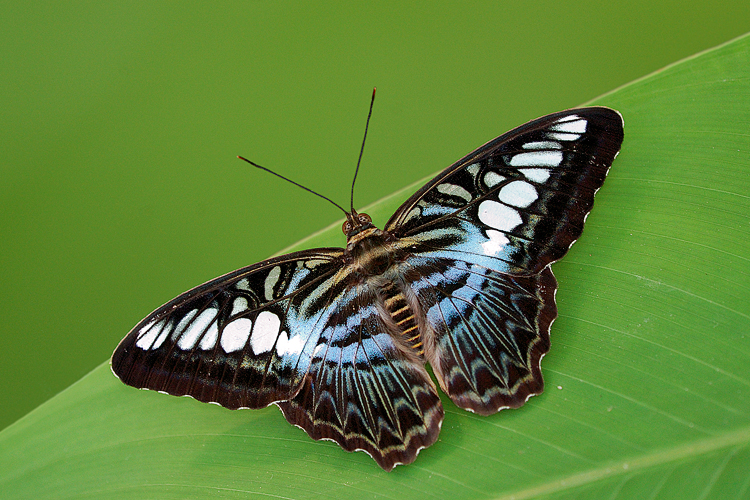
The Clippers (Parthenos)

order Lepidoptera → superfamily Papilionoidea→ family Nymphalidae → subfamily Limenitidinae→ tribe Parthenini → genus Parthenos→ 

Introduction
The genus Parthenos comprises of 3 species, sylvia, tigrina and aspila. The latter 2 are endemic to Papua New Guinea, while sylvia in comparison has an extremely wide distribution being found in Sri Lanka, India, Myanmar, Thailand, Malaysia, Borneo, Sumatra, the Philippines, Sulawesi, Java, Bali, Papua New Guinea and Irian Jaya.
Habitats
This species is found in primary rainforest, usually in the vicinity of rivers, at elevations between sea level and about 300 metres.
Lifecycle
The larva is brown, speckled with white dots, and has broad greenish dorsal and lateral stripes. Each segment bears 4 multi-branched spines, purplish brown at the base and red on the outer half. The larval foodplants include Adenia ( Passifloraceae ) and Tinospora ( Menispermaceae ).
The chrysalis occurs in 2 forms, either pale green or dark olive. It is rather plain in appearance, without protuberances, and is suspended by the cremaster from beneath a leaf.
Adult behaviour
The Clipper is a powerful and fast flying butterfly. The flight consists of short periods of gliding, alternating every few seconds with shallow but rapid flickering wing beats.
On the Kinabatangan river in Borneo I have observed hundreds of these magnificent butterflies circling and gliding around tree tops along several kilometres of the river edge.
Both sexes commonly nectar at Lantana and other flowers. Males will also settle on the ground to imbibe moisture. If disturbed they fly up immediately, circle around at a height of about 3 metres, and then resettle nearby.


                                            Parthenos Sylvia

Male and female. Upperside : ground-colour a bright purple, the subhyaline white spots near the apex of cell in the fore wing more opaque, the broad discal band of large white spots proportionately more basal further from the termen and very irregular, the spots, especially towards the hinder part of the wing, more widely separated, the spot in interspace 5 more acutely triangular and smaller, the two spots above shifted obliquely inwards towards the costa, making the outer margin of the discal band angulate at interspaces 5 and 6. Hind wing: the postdiscal and sub-terminal markings broader and more diffuse than in P. gambrisius, giving a dark shade to the whole of the apical half of the wing. 
Underside pale greenish grey. Fore wing: the spots and markings except the basal black streaks as on the upperside, the groundcolour fading to an ashy grey towards the terminal margin. Hind wing similar to the underside of hind wing of P. gambrisius, but the discal transverse sinuous black line very broken and incomplete, the postdiscal, subterminal and terminal black markings somewhat better denned. Antennae black; head, thorax and abdomen bronze green, barred with black above ; beneath whitish.
Parthenos Sylvia

                                                        Parthenos Tigrina


                                Parthenos Aspila


World of butterfly

                                     What are Butterflies?


Butterflies and moths come from the same group of insects, which is the order of Lepidoptera. The word Lepidoptera is derived from Greek, which means "scaly wings" or λεπίδος (scale) and πτερόν (wings). The beauty of butterflies is also recognised and appreciated by its wings through the variety of colours, patterns, sizes and shapes. Some butterflies such as the Blue Morpho has an iridescent blue coloured wings, which allows them to be known as the world's most beautiful butterfly.
Detailed Wings of ButterfliesEnlarged under a microscope :- scales on the wings of a butterfly.
These scales can detach from the wings easily upon touching them, which feels like fine powder on your fingers.


Similar to other insects, butterflies have 2 pairs of wings, 6 legs, 3 body parts (head, thorax & abdomen), a pair of antennae, compound eyes, a proboscis and an exoskeleton.

Lifecycle of a Butterfly

Butterflies undergo four stages in their lives, which is known as a complete metamorphosis.
  1. Egg
  2. Larva (Caterpillar)
  3. Pupa (Chrysalis)
  4. Imago (Adult Butterfly)


Common Butterflies of Malaysia

Troides helenaYellow Birdwing (Troides helena)
Parthenos sylviaThe Clipper (Parthenos sylvia)
Precis almanaPeacock Pansy (Junonia almana)
Papilio polytesCommon Mormon (Papilio polytes)
Papilio demoleusCommon Lime (Papilio demoleus)
Parantica aspasiaYellow Glassy Tiger (Parantica aspasia)
Idea leuconoePaper Kite / Rice Paper (Idea leuconoe)
Danaus chrysippus Leapord Lacewing (Cethosia cyane)
Doleschalia bisaltideAutumn Leaf (Doleschalia bisaltide)


Butterfly vs moth


Polaroid Camera

                                        Polaroid Camera

I gonna tell you about how instant film works. 


                           How instant film works?

The secret is in the film. As soon as you press the button on your camera it shut it open and quickly captured your photo. It takes sense the pattern of light and prints it on the plastic film that is cover in silver compound. There are 3 silver compounds. These compounds are sensitive to blue, green and red light. There are four chemical waiting to react, the developer layer, Acid layer, Timing layer and image layer. The chemicals get set off by reagent. Reagent is substance use in a chemical reaction to dectect ,measure, examine or produce other substance.


Every instant photo cointains packets of photo chemicals inside to develop your photo.
Your camera squeezes these chemicals thorough rollers and spreads them over to start development.

This is the layer in the film.

Thursday, February 5, 2015

💐Penang Steel Rod Sculptures🌸


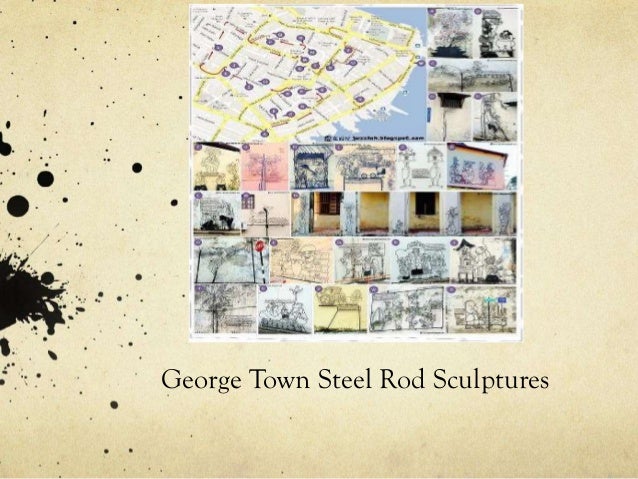
The Marking George Town Steel Rod Sculptures is a collection of caricatures placed on historic streets of George Town by the company, Sculpture at Work. The company on 29 March, 2010, won the design idea competition organized by the Penang State Government on 7 September, 2009.

The concept presented by Sculpture at Work is to relate the history and/or characteristic of selected streets in George Town using steel rod caricatures of local cartoonists. The reason is to make the history of George Town interesting and easily grasped by visitors and residents, the young and the old.


List of Cartoonists Involved
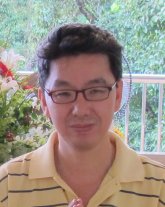

This is Baba Chuah

Baba Chuah George Town Caricature Sculptures is a set of steel-rod sculptures placed at strategic locations in George Town. They are the work of local cartoonist Baba Chuah. Chuah made his debut in the cartoon scene when he was published in Falsafah Batu Api in 1991. This led to the use of his work by Creative Enterprise for their "Fantasi" anthology series.

In 2000, Baba Chuah entered the international scene when his work, Midsummer Night's Hunt, was published by the US publisher, Dark Horse, in Issue No. 156. Today Chuah continues to be heavily involved in the comics scene. So far, three of his caricatures have been selected for the street art commission by the Penang Island Municipal Council (MPPP) though the design company, Sculpture at Work.

       The following are some of Baba Chuah's caricature sculptures in                                                              George Town. Baba Chuah has make 5 sculptures.
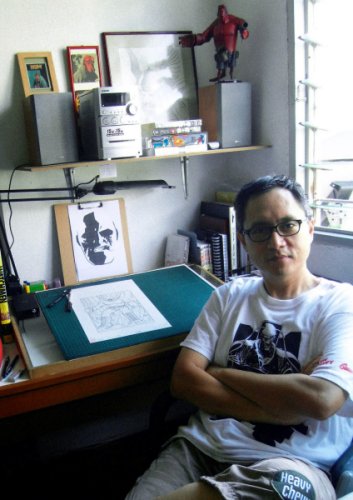


The George Town Caricature Sculptures by Lefty are among those that were used in the Marking George Town project.

Julian "Lefty" Kam was an Art Director and Editor for several publications in Malaysia and Singapore. His Major Zombie series is one of the flagship titles for Gilamon Studio. He has also contributed to Image Comics' Liquid City vol 1 and 2.

Lefty's latest work, Jimi Germ, won an Intellectual Property Creators Challenge (IPCC) grant from MDeC (Multimedia Development Corporation - Malaysia). Lefty has make 5 sculptures and 1 mural.
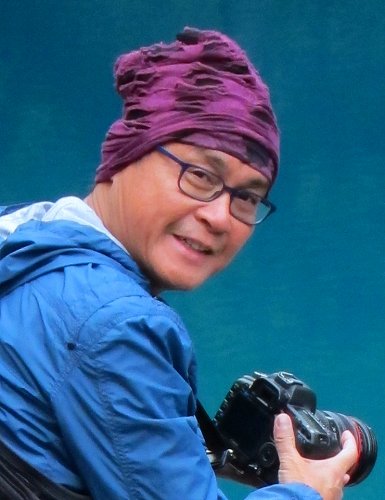


Reggie Lee is one of the cartoonists involved in contributing caricatures for the Marking George Town project, which was won by the design company, Sculptureatwork Studio. Reggie brings his own brand of humour to life in everything from cartoons to billboards and even movies. With his inimitable wit, he has created unique Malaysian characters, each with a distinctive personality that's instantly recognisable.

For heritage buildings in Penang, Reggie created quirky metalcraft tableaus that transcend race and culture. Commissioned for the launch of the Petronas Twin Towers, he worked with world class experts to project his Malaysian caricatures many storeys high in a special collaboration of creativity and technology.

As a syndicated cartoonist, Reggie's cartoons appear in Malaysia's largest daily, The Star, as well as internationally. Probably the world's only artist to have his creations appear in so many mediums from cyberspace to moviespace, Reggie continues to explore diverse ways in which to express                                                                               himself, including travel features and fine art.
 The following are the steed-rod sculptures that have been                                                                        installed in George Town, based on Reggie Lee's                                                                                    caricatures. Reggie Lee has make 11 sculptures.


The George Town Caricature Sculptures of Tang Mun Kian adorn many street corners and strategic locations all overGeorge Town, Penang. It is part of a project known as Marking George Town that was initiated by the Penang Island Municipal Council (MPPP) to celebrate the history and heritage of the city. The concept proposed by Sculptureatwork Studio, which tossed out a dry telling of history for a wittier take on George Town, won the hearts of the judges. This has succeeded in attracting the attention of street users, both visitors and locals.

The artist, designer and cartoonist behind these wire sculptures is Tang Mun Kian. A graduate of the Malaysian Institute of Art, he dabbled as an advertising art director for a decade in Singapore before moving his base to Kuala Lumpur.

Mun Kian, whose significant other comes from Penang, has at time of writing (July 2012) fourteen of the twenty-four sculptures being installed all over town. More are on the way and will be highlighted here when installed. Tang mun Kian has make 29 sculptures.


Penang Street Art (Murals)

   
                                                 Penang Street Art

Last week, I was at George town,Penang. I see that in every route wall there is a painting. The painting is create by Ernest Zacharevic. 


                          Ernest Zacharevic

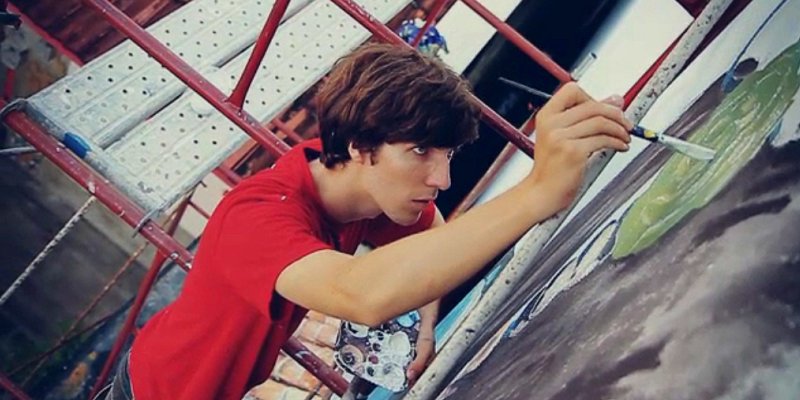
Ernest Zacharevic is a young Lithuania-born artist who is "making a scene" in Penang, particularly on the streets of George Town, Penang. This comes in the form of beautifully executed wall paintings, or murals, at selected streets in the inner city. The project, known as Mirrors George Town, is part of George Town Festival 2012.

Ernest Zacharevic's wall paintings in George Town include figure drawings and portraitures that celebrate the exuberance of life in the inner city. They range from the pensive "Boy on a Bike", the lively "Little Children on a Bicycle" to the whimsical "Little Boy with Pet Dinosaur". 


The process began with Zacharevic combing the city, looking for suitable walls. After he has selected the walls to be painted, the Penang Island Municipal Council (MPPP) contact and obtain a signed agreement from the property owner. Then he starts working on his mural. In the process, he is generating much interest from passer-by traffic, becoming a welcoming sight in the city. As the project becomes increasingly popular, more people started offering their walls.

The following are the completed murals. Note that these murals were never given names, but I have taken the liberty to provide a descriptive name for each, to help them easily recognisable.


Here are some of the painting list:


  1. “Little Girl in Blue Mural at Muntri street,George town, Penang
  2. Children in a boat Mural, Chew Jetty, George Town, Penang
  3. Little children on a bicycle Mural, Armenian Street, George Town, Penang
  4. “Boy on a Bike” Mural, Ah Quee Street, George Town, Penang
  5. “Little Boy with Pet Dinosaur” Mural, Ah Quee Street, George Town, Penang
  6. “Reaching Up” Mural, Cannon Street, George Town, Penang
  7. “The Awaiting Trishaw Paddler” Mural, Penang Road, George Town, Penang
  8. This Old Man Mural, Armenian Street, George Town, Penang 
  9. Broken heart  Mural Love Lane